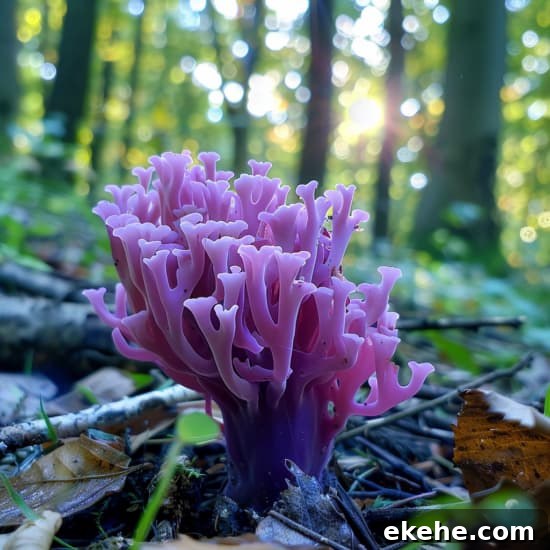
Clavaria zollingeri, commonly called the Violet Coral Fungus, is a vivid violet or lavender fungus with a branching, coral-like structure that often draws attention in woodlands and forest floors.
In this article you will learn:
- How to identify Violet Coral
- Whether Violet Coral is edible
- Where it grows
- Whether it is poisonous to humans
How to identify Violet Coral (Clavaria zollingeri) in the wild
Clavaria zollingeri is typically found on the ground in moist, shady parts of woodlands and mixed forests, often among leaf litter, moss, and decaying wood. It favors temperate climates and appears across North America, Europe and parts of Asia.
- Season — Fruits most commonly from late summer into autumn, timing varying with local climate.
- Fruit body — The mushroom forms branching, coral-like clusters of slender, cylindrical arms. Individual colonies can reach roughly 5–10 cm tall and several centimeters across, depending on conditions.
- Texture — Surfaces are generally smooth; branches tend to be brittle and can snap easily when handled.
- Colour — Distinctive violet to lavender hues, ranging from deep purple to paler shades. Colours often deepen when the fungus is well hydrated and may fade with age or in dry conditions.
When identifying this species, note the combination of vivid violet colouring, coral-like branching and fragile texture. These features together help distinguish it from other similar coral fungi.
Where Violet Coral mushrooms grow
Violet Coral (Clavaria zollingeri) has a broad temperate distribution and appears in several regions worldwide, typically in shaded, moist habitats:
- North America — Frequently found in temperate forests of the eastern United States and Canada, with occasional records elsewhere.
- Europe — Recorded across the UK, Ireland and much of central and northern Europe in suitable woodland habitats.
- Asia — Present in temperate regions of Asia, with documented occurrences in countries such as Japan and China.
- Australia and New Zealand — Also reported in some locations in the Southern Hemisphere where conditions support its growth.
Habitat and ecology
Violet Coral prefers moist, shaded environments within deciduous and mixed forests. It is saprobic, meaning it obtains nutrients by decomposing dead organic matter such as leaf litter and fallen wood. These ecological habits make it an important contributor to nutrient cycling in forest soils.
Are they edible?
Violet Coral is not regarded as a choice edible. Although it is not widely recorded as poisonous, it has limited culinary value for several reasons.
The texture is generally unappealing—branches can be tough or rubbery when cooked—and the flavor is often described as bland or slightly bitter. Because its edibility has not been thoroughly documented and toxicological data are limited, foragers and mycologists advise against eating it. When in doubt, rely on well-studied species and expert identification before consuming any wild mushroom.
Most enthusiasts prefer to admire Clavaria zollingeri for its striking colour and form rather than collecting it for the table.
Is Violet Coral fungus poisonous to humans?
No specific toxins have been definitively identified in Clavaria zollingeri, so it is not generally classified as poisonous. However, absence of known toxins does not guarantee safety. The combination of an unpalatable texture, uncertain edibility and limited toxicology means eating this species carries unnecessary risk.
For safety, treat Violet Coral as an inedible or at best untested species. Always consult experienced mycologists or local mushroom clubs and reliable guides before considering consumption of any wild fungus.
Clavaria zollingeri (Violet Coral Fungus) etymology
The genus name “Clavaria” comes from the Latin “clava,” meaning “club,” a reference to the elongated, club-like fruiting bodies typical of many species in the genus. The species epithet “zollingeri” honors Swiss botanist Heinrich Zollinger (1818–1859), recognizing his contributions to botanical and mycological studies. Together, the name reflects both the fungus’s form and a historical nod to a notable botanist.